Readers & Writers
GeoBrix provides Spark DataSource V2 readers and writers for geospatial file formats,
across both execution tiers — lightweight (pyrx, pure-Python, no JAR) and heavyweight
(rasterx, GDAL/OGR-backed). Both tiers scale by partitioning work across the cluster rather
than reading or writing sequentially on a single node.
Each lightweight *_gbx format pairs with a heavyweight counterpart (*_ogr / gdal /
gtiff_gdal), and the two tiers are held to row-count / byte parity as a hard gate in
benchmarking.
Readers
Load geospatial files into a distributed DataFrame. The lightweight raster readers (raster_gbx, gtiff_gbx, cog_gbx) return virtual tiles by default — bytes-free (path, window) references; pass .option("virtualTiles", "false") to get materialized bytes instead. See the Readers Overview
for the full list, tier differences, output schemas, and options.
Parenthetical (x.y.z) is the GeoBrix release each reader/writer first shipped (its "since" version).
| Format | Lightweight | Heavyweight |
|---|---|---|
| Raster (generic) | raster_gbx (0.4.0) | gdal (0.2.0) |
| GeoTIFF | gtiff_gbx (0.4.0) | gtiff_gdal (0.2.0) |
| COG | cog_gbx (0.5.0) | — (light-only) |
| NetCDF | netcdf_gbx (0.4.1) | netcdf_gdal / netcdf_ogr (0.4.3) |
| PMTiles | pmtiles_gbx (0.4.0) | — (light-only) |
| File lister | file_gbx (0.5.0) | — (light-only) |
| LiDAR (LAS/LAZ) | lidar_gbx (0.5.2) | — (light-only) |
| EXIF/GPS (images) | exif_gbx (0.5.2) | — (light-only) |
| Vector (generic) | vector_gbx (0.4.0) | ogr (0.2.0) |
| Shapefile | shapefile_gbx (0.4.0) | shapefile_ogr (0.2.0) |
| GeoJSON | geojson_gbx (0.4.0) | geojson_ogr (0.2.0) |
| GeoJSONL | geojsonl_gbx (0.4.0) | — (light-only reader) |
| GeoPackage | gpkg_gbx (0.4.0) | gpkg_ogr (0.2.0) |
| File Geodatabase | file_gdb_gbx (0.4.0) | file_gdb_ogr (0.2.0) |
Writers
Write DataFrames back out to geospatial files. See the Writers Overview for the column contract, single-file vs sharded trade-offs, and per-format details.
| Format | Lightweight | Heavyweight |
|---|---|---|
| Raster (generic) | raster_gbx (0.4.0) | gdal (0.2.0) |
| GeoTIFF | gtiff_gbx (0.4.0) | gtiff_gdal (0.2.0) |
| COG | cog_gbx (0.5.0) | — (light-only) |
| PMTiles | pmtiles_gbx (0.4.0) | pmtiles (0.4.0) |
| NetCDF | netcdf_gbx (0.4.1) | — (light-only) |
| LiDAR (LAS/LAZ) | lidar_gbx (0.5.2) | — (light-only) |
| Vector (generic) | vector_gbx (0.4.0) | — (light-only) |
| Shapefile | shapefile_gbx (0.4.0) | — (light-only) |
| GeoJSON | geojson_gbx (0.4.0) | — (light-only) |
| GeoJSONL | geojsonl_gbx (0.4.0) | geojsonl_ogr (0.4.0) |
| GeoPackage | gpkg_gbx (0.4.0) | — (light-only) |
| File Geodatabase | file_gdb_gbx (0.4.0) | — (hybrid; needs native GDAL) |
Registering the lightweight tier
Heavyweight readers and writers are auto-discovered from the JAR. The lightweight Python
DataSources are not auto-registered — call register(spark) once per session before using
any *_gbx format:
from databricks.labs.gbx.ds.register import register
register(spark)
Shared file-access base
All lightweight (*_gbx) readers and writers share a common file-access base — the
file_gbx module — that centralises FILE and FUSE routing, directory enumeration, and
write-mode selection. This is a light-tier concern; the heavyweight (JAR-backed) readers
and writers use their own GDAL/OGR access paths.
Capability tiers
file_gbx probes the runtime once per session and picks the best available tier:
| Tier | Available on | Capabilities |
|---|---|---|
read_files | DBR 13.3 LTS + | read_files(format=>'file') — native FILE refs, file metadata, recursive listing |
list_files | DBR 18 LTS + | list_files(…) — metadata + FILE refs, directory listing only |
fuse | All runtimes (OSS / DBR < 13) | os.walk + FUSE mount — always available; no FILE column |
Read-options matrix
Measured on 1,000 raster tiles or 100k vector features; times are whole-job wall-clock.
| Source | Read mechanism | Runtime | Serverless | Classic | Default / when |
|---|---|---|---|---|---|
| FILE-column table (recommended on Serverless) | Delta scan of path (EXTERNAL) | any | ~2 s | ~2 s | default for a table source (vector_file_read(table), raster tilesTable) |
| FILE-column table | Delta scan of FILE .uri (MANAGED) | DBR 13.3+ | ~2 s | ~2 s | auto when the table is MANAGED |
| Directory | read_files(format=>'file') — enumerate + FILE refs + size | DBR 13.3+ | ~10 s / 10k (enumerate) | ~same | auto dir default on 13.3+ |
| Directory | list_files — enumerate (metadata only) | DBR 18+ | ~10 s / 10k (enumerate) | ~same | used when read_files is unavailable |
| Directory | FUSE walk + per-tile open (raster_gbx DataSource) | all | ~30 s / 1k ⚠️ | ~20 s / 1k | fallback tile read (no FILE tier); slower than the Delta-table path on all runtimes |
The read_files/list_files rows time the listing step (per 10k files, comparable, metadata-bound). The Delta-scan and DataSource rows time the actual tile read/open (per 1k tiles). The performance gap is the per-tile open/decode cost, not listing — the Delta-scan FILE-column-table path (~2 s) beats the DataSource directory scan by ~10× on classic and ~16–17× on Serverless (~2 s vs. ~30 s per 1k tiles). On Serverless, prefer reading from a FILE-column table (Delta scan). See Serverless & Memory for the connect-aware stream caps (64 MiB on Serverless/Connect, 256 MiB on classic) and a full guide to memory-safe pipelines.
The no-gating rule: the auto default (access="auto" on readers, file_mode="auto" on
writers) silently downgrades to the best available tier and never errors. Explicitly requesting
"managed" or "external" on a FUSE-only runtime raises a clear, actionable error
describing the upgrade path. Your pipelines run on any runtime without code changes; you
only need to opt in to FILE when you want the governance and lifecycle benefits.
Read resolver
When a lightweight reader opens a source file it calls open_for_read(source, access="auto").
The resolver checks the tier and picks a strategy:
- FILE-capable runtime (DBR 13.3+): routes to the FILE API. Files at or under
GBX_STREAM_MAX_BYTES(default 64 MiB on Serverless/Connect, 256 MiB on classic) open a byte-range stream — one round-trip, no FUSE, no local copy, and the fastest path for typical tile sizes. Files over the cap fall through toas_local_file()— a lazy local-file reference backed by the FILE handle — which pages bytes from the Volume on demand and is a memory-safety mechanism, not a performance optimization. A blanket FUSE-direct path for small files is slower, not faster; the streaming path is preferred whenever the file fits in the cap. Open dataset handles are held in a per-partition LRU cache keyed by source path, amortising the open cost across all windows of the same source. - FUSE fallback (OSS / DBR < 13): resolves to the bare
/Volumes/…path and uses a probe-then-stage strategy — tries random-access directly; falls back to a sequential copy only if the probe fails.
Write committer
Writers call open_for_write(spark, df, target, file_mode="auto", filespace=…, layout=…).
file_mode="auto" resolves as follows:
| Condition | Effective mode | Mechanism |
|---|---|---|
FILE available + filespace given | "managed" | create_file — MANAGED FILE column |
FILE available, no filespace | "external" | try_to_file — EXTERNAL FILE column |
| No FILE (fuse tier) | "fuse" | Plain Delta write, path STRING / raster BINARY |
Explicit modes ("managed", "external", "fuse") override auto-selection. Requesting
"managed" or "external" on a fuse-only runtime raises a clear error.
Layout options
The layout parameter controls row ordering in the output Delta table:
| Value | Behaviour |
|---|---|
"order" | ORDER BY path at write time (default — scan-friendly) |
"cluster" | CLUSTER BY path in the DDL (FILE-mode tables only); run OPTIMIZE <table> afterward for durable clustering |
"plain" | No ordering — fastest write, scan order determined by the cluster |
partitionBy is not supported; use layout="order" unless you have a specific clustering need.
File enumeration
enumerate_files(path, *, recursive=True, include_hidden=False, extensions=None, path_glob_filter=None)
lists files in a directory and returns a Spark DataFrame (FILE-capable tiers) or a Python list (FUSE tier),
with columns path, size, and file (a FILE reference when available, None on FUSE).
By default, files whose names start with _ or . (Spark/Hadoop metadata files such as
_SUCCESS, _committed_*, .crc) are skipped. Pass include_hidden=True to include them.
A positive selection filter — either extensions (a tuple of suffixes, e.g. (".tif", ".nc"))
or path_glob_filter (an fnmatch-style glob, e.g. "*.tif") — narrows which files are returned.
The two filters are mutually exclusive and are ANDed with include_hidden: for example,
include_hidden=True + path_glob_filter="[!.]*" returns underscore-named files such as
_data.tif but still excludes dot-named files such as .crc.
Light-tier FILE flow
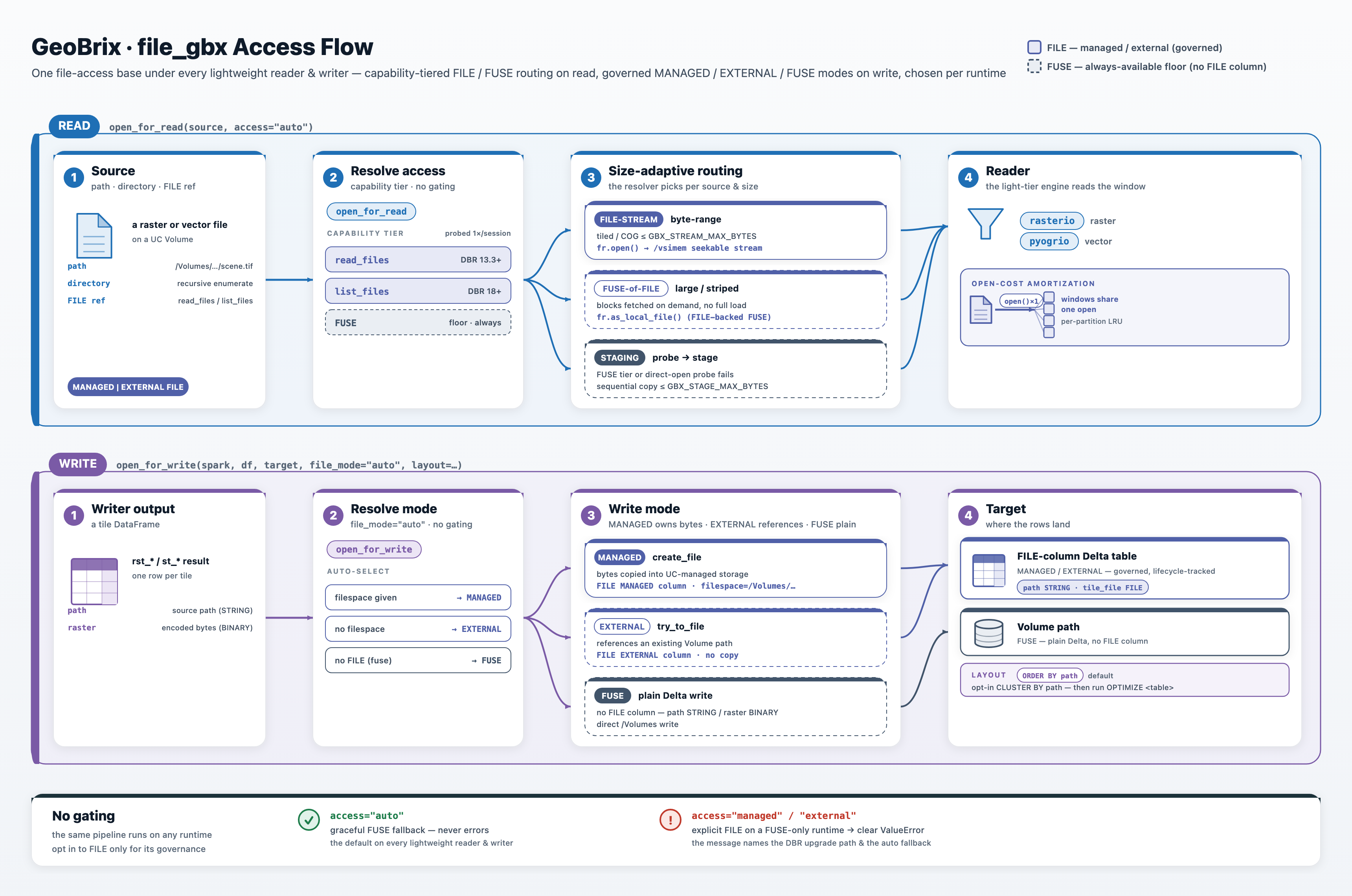
See file_gbx Reader for enumeration and read-mode details, and
file_gbx Writer for write-mode and ingest options.
Next Steps
- Readers Overview — every reader, tier differences, output schemas, options.
- Writers Overview — the column contract, single-file vs sharded writers, per-format details.
- VRT & Mosaics — tile a large source into bounded mini-COGs + a portable VRT index; read back with
raster_gbxorcog_gbx. - Serverless & Memory — connect-aware caps, materialize-vs-virtual, memory-safe write patterns, and caveats.
- Benchmarking — tier-vs-tier timing and parity methodology.