Data collaboration
Data collaboration on Databricks enables secure, governed sharing of data assets across organizations, clouds, and platforms. Using OpenSharing—the first open protocol for secure data sharing—providers can share tables, views, volumes, notebooks, AI models, and more without copying data or managing complex access controls.
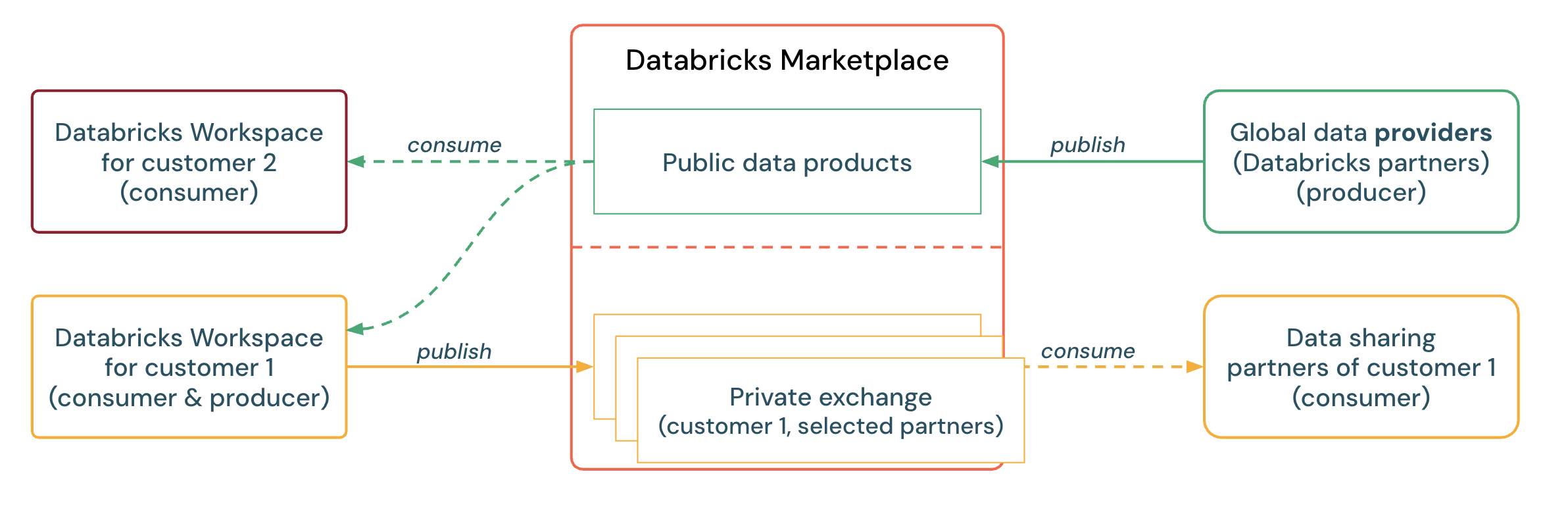
The Databricks Marketplace extends this capability by providing a discovery and distribution platform where data providers can publish, monetize, and manage their data products at scale.
Who this is for
This guide is for data providers who want to share data through Databricks Marketplace or OpenSharing. It covers:
- Technical best practices for preparing and sharing data
- Go-to-market considerations for Marketplace listings
- Operational guidance for managing data products over time
This guide assumes your data already exists within Databricks and is registered in Unity Catalog. It does not cover upstream ingestion or ETL processes.
In this section
| Topic | Description |
|---|---|
| OpenSharing | Share types: tables, views, volumes, notebooks, models, MCP, and Genie Agents |
| Data as a Product | Productizing your data with Unity Catalog layout and metadata |
| AI readiness | Checklist for optimizing shared data for Genie and AI tools |
| Sharing Genie Agents | Share pre-configured AI analysts with external customers via OpenSharing |
| Sharing patterns | D2D, D2O, and O2D sharing best practices |
| Access & Distribution | Recipients, entitlements, and Marketplace listings |
| Operations | Access management, monitoring, and provider runbook |
| Software-Defined Storage | Blueprint for governed on-premises data sharing via OpenSharing |
What's next
- Understand OpenSharing and the asset types you can share
- Learn how to productize your data for sharing
- Explore sharing patterns for D2D and D2O scenarios
- See how to share Genie Agents for AI-powered data experiences
- Learn how Software-Defined Storage extends governance to on-premises data estates